Financial Wellness for Touring Professionals: A Practical Guide
The financial reality of working in live events doesn't match the advice most people grew up with. No employer-matched 401k. No steady paycheck. Tax bills that arrive as a surprise. A career that can go from feast to drought without warning. The standard personal finance playbook wasn't written for people who spend half the year on a bus.
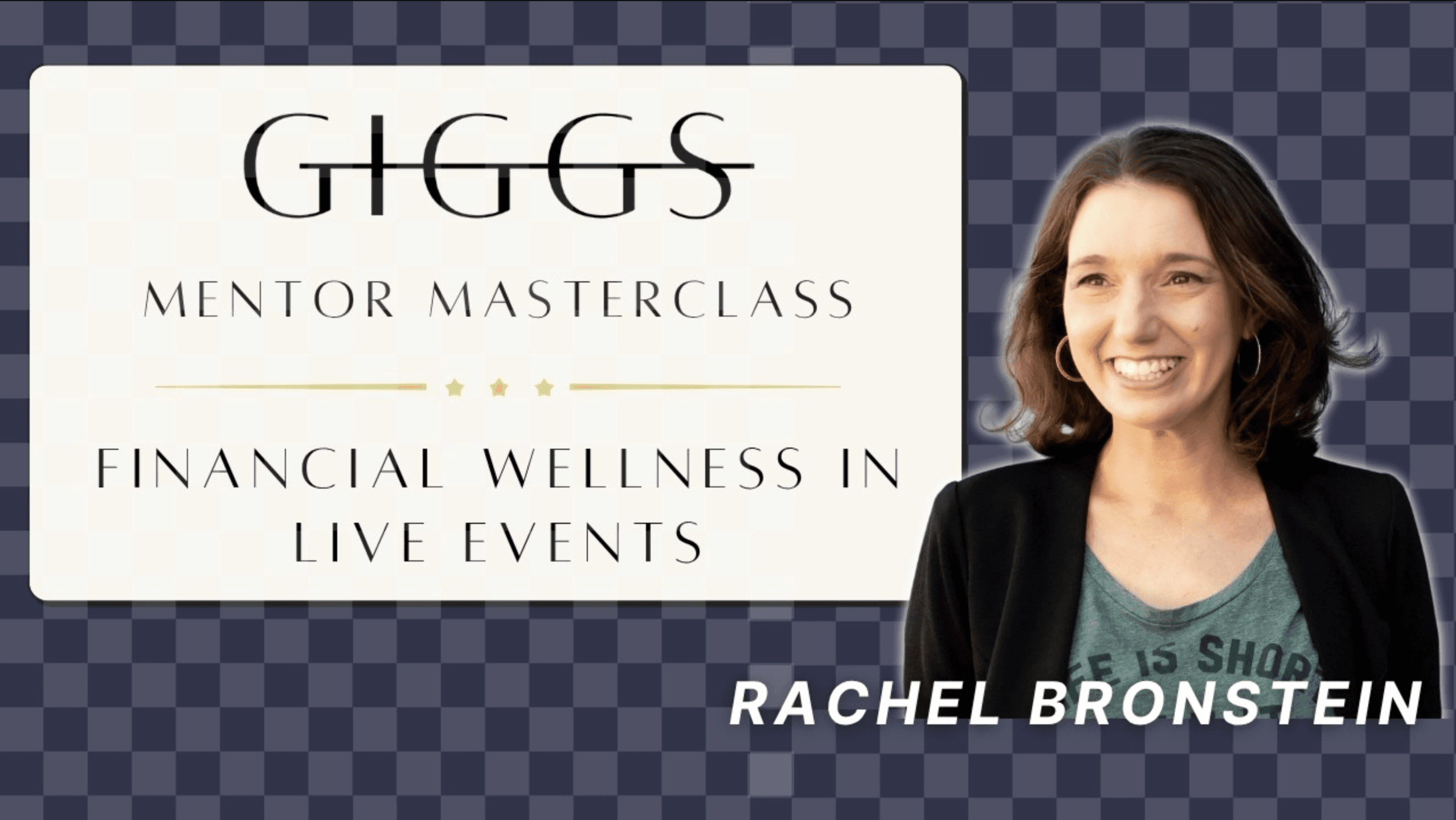
Rachael Bronstein, AFC®, founded Life's Jam specifically to address that gap. An Accredited Financial Counselor who started her career in production finance at NBC, Rachael built her coaching practice after watching the live events community get decimated during the pandemic — and realizing there was almost no financial infrastructure to support it. She now works one-on-one with touring professionals, coaches crews on the road, and built the financial coaching program at MusiCares.
Her Giggs Mentor Masterclass covered the practical fundamentals: how to think about money as a freelancer, how to structure your accounts, how to save for retirement without a corporate benefits package, and how to protect what you've built. What follows is drawn directly from that session.
Start With What Actually Matters to You
Before tracking a single dollar, Rachael starts every client engagement with a question most financial advice skips entirely: what matters to you?
"Finance is just a math problem. But it's overcomplicated because we're humans and we have feelings and thoughts and emotions and we might have grown up a certain way thinking about money that we take into adulthood."
The exercise is straightforward: identify the things that actually light you up — flexibility, travel, adventure, safety, education, whatever genuinely drives you. Then look at your spending from the last 30 to 45 days and ask whether your money is going to those things. For most people, the answer is not really.
This is the foundation. When you understand what you're working toward, spending decisions have context. Money stops being a source of anxiety and starts being a tool. That reframe is where financial coaching begins — and it's also what separates a plan you'll actually follow from one that looks good on a spreadsheet and falls apart in week two.
How to Actually Look at Your Spending
Rachael doesn't believe in building a budget from scratch. "We can make it look perfect on paper, but it doesn't mean it reflects our real life." Instead, she works from a 30 to 45-day lookback — real transactions, real categories, real patterns.
She breaks spending into three buckets (and a fourth bonus):
Fixed expenses are the non-negotiables: rent, utilities, car payment, insurance. Most people have a decent handle on these because they don't change much month to month.
Flexible spending is everything that varies — groceries, restaurants, shopping, the quick card swipes. This is also where touring creates unusual patterns. Some weeks on the road, crew spend almost nothing. Other weeks at home can be expensive. The flex category needs to account for that swing.
Non-monthly expenses are where people consistently get caught off guard. Holiday gifts, annual subscriptions, car repairs, conference travel — these are predictable costs that get treated as surprises. "We knew the holidays were coming. If we had set up some intentions around it, the money is there waiting for you." Building this category means January doesn't come with a credit card bill that takes months to recover from.
Savings — both emergency fund and retirement — gets treated as a fourth category, but with one important distinction: Rachael puts it at the top, not the bottom. The old model of "save whatever's left" doesn't work in this industry. Savings needs to be a fixed monthly transfer, treated like a bill, before the rest gets allocated.
The Three Expenses That Make or Break Everything
Once you have your categories mapped, Rachael focuses on three line items first: housing, transportation, and food. "These are the three biggest things usually in our spending. And if they're not in check, it makes all the other stuff really hard."
Housing is the most emotionally charged one for touring professionals. Time on the road means time away from home — and many touring folks over-extend on housing because it represents stability, a place to decompress, something to return to. That's understandable.
"I have found that touring folks need stability and so a lot of them are extending themselves a bit more on housing because it gives them something to come back to that refills their tank."
The tension is that the apartment is also sitting empty for months at a time, still charging full rent.
Transportation is another place where the math can get quietly uncomfortable. A car payment that made sense for someone home every night starts looking different when you're on tour six months of the year and the car is parked in a garage.
Rachael shared the example of a Nashville finance professional whose team teased him for showing up in a different rental car every week — he'd done the math and found renting was genuinely cheaper once he factored out maintenance, depreciation, and the fact that he traveled constantly.
"In his particular case, the numbers were more important to him than the car he showed up at an event in."
It's not the right move for everyone, but the point is: run the numbers before assuming.
The practical guideline: aim to keep transportation (car loan plus insurance) under roughly 10% of take-home pay, and housing under 28% — though in expensive cities that's a real stretch, and Rachael treats these as guides rather than hard rules. If you can keep those two in range, the rest becomes workable.
The Account Structure That Does the Tracking For You
Apps, spreadsheets, and budgeting tools all have a place — but for busy touring professionals, Rachael has found that the most effective system is structural. How you set up your accounts does most of the work.
Her recommended setup uses three accounts:
A bills account handles all fixed expenses. Everything automated, nothing to think about.
A spending account receives a set weekly or monthly transfer — whatever you've determined is your flex budget. This is the no-judgment account. You've already handled everything else. "If you want to go on a shopping spree, go out to fancy restaurants, invest in a course — you can do it guilt-free." If you have a light week and don't spend it all, the money stays. If you want to spend more the following week, it's there. Crucially: if it's gone, it's gone. That feedback is immediate and clarifying.
A high-yield savings account for everything else — taxes, emergency fund, car repairs, vacation, gear purchases, whatever goals you're working toward. Rachael's current recommendation is Ally, specifically because it supports virtual buckets. You label each bucket by purpose — taxes, car fund, holiday gifts — and the money sits earmarked. When estimated tax payments are due, the money is already waiting. No scrambling, no surprise.
"The idea is to build intentions so you can make educated decisions in the moment without it being too much work."
Retirement When You Don't Have a 401k
This is the piece most people in live events put off the longest. And it makes sense — when income is irregular and the present feels urgent, the future is easy to defer.
But Rachael is direct about it: "Even if you're technically a W2 for a tour, that means the tour is paying you as an employee while you're on tour for five or six months, but you're not getting any benefits, including retirement in most cases. You have to be your own best advocate."
Step one: know what you're eligible for. For individuals with 1099 income, options include the traditional IRA, the Roth IRA (currently $7,000 annual contribution limit), and for those running a business with meaningful net profit, the SEP IRA, Simple IRA, or Solo 401k. Rachael pointed newer contributors toward the Roth IRA as a starting point — contributions are after-tax, and the money grows and comes out in retirement tax-free. Large brokerage platforms like Fidelity, Vanguard, and Schwab all have user-friendly setups.
Step two: open the account and fund it. And step three — which sounds obvious but gets skipped more than you'd think: pick the investments. Rachael shared a story from a crew meeting where a band member's husband had opened a retirement account at 18 and, in their late 30s, they realized he'd never selected investments. The money had been sitting in a cash account for nearly two decades, earning essentially nothing. "Time is your biggest advantage. Make sure you have picked an investment."
Step three: automate it. If the full recommended 15% feels out of reach right now, start at 5%. "You only have to make that decision once or twice a year rather than every time you get paid." Set it, then revisit it every six months or annually and bump it up when you can.
The Feast-or-Famine Problem — And How to Flatten It
Irregular income is one of the defining financial challenges of working in live events. One month brings $15,000. The next brings almost nothing. Most people ride that wave emotionally — spending more when money is there, stressing when it's not.
Rachael's solution is to pay yourself like an employer pays an employee. All income flows into a business checking account first. Then you determine what you actually need to live each month — let's say $5,000. That's your paycheck. You transfer exactly that, every month, regardless of what came in. When you earn $15,000, the extra $10,000 stays in the business account to fund the months where work is slow. The roller coaster flattens.
This approach also builds a savings cushion without requiring constant discipline. "If you want to kind of start by seeing if you like that lifestyle — it's not for everybody. Some people need that predictable paycheck." But for those building a freelance career in this industry, learning to manage money this way early is one of the most protective things you can do.
On the emergency fund side, the conventional wisdom of three to six months of expenses is a floor for this industry, not a target. "A lot of income in this field is fluctuating. We go from earning to then not having any money for three months." That three-month gap isn't truly an emergency — it's predictable. Building a cash reserve that accounts for your actual earning pattern, rather than treating slow seasons as crises, is a more realistic and less stressful approach.
LLCs, Write-Offs, and What's Actually Worth It
A question from a 20-year freelancer — who'd never formed an LLC and wasn't sure it was worth it — prompted a clear-eyed breakdown.
The main reason people form LLCs isn't tax savings — it's liability protection. As a sole proprietor, your personal assets (home, savings, investments) are exposed if something goes wrong professionally. An LLC creates a legal separation between business and personal. "If you own a home or you have assets, people are wanting to protect those."
On write-offs specifically: a single-member LLC doesn't change what you can deduct. Write-offs flow through Schedule C of your personal tax return whether you're operating as a sole proprietor or an LLC. The LLC is a business structure, not a tax strategy.
What does change with an S corp election — and only potentially, with a proper calculation — is self-employment tax on the profit portion of your income. But Rachael put a practical threshold on it: "You need to be making about a net profit over $60 or $70,000 for it to be worth it to entertain being an S corp." S corps require their own tax return (which costs more to prepare), payroll administration, and careful recordkeeping throughout the year. The math has to actually work.
Her consistent baseline advice regardless of structure: get a dedicated business checking account and a business credit card. Run all business income and expenses through them.
"You will never be able to recreate it exactly the way the year happened when you're doing it in April trying to look back at a whole year of data. You're much better off doing it as you go."
Don't Forget to Protect What You've Built
Once the financial foundations are in place, Rachael rounds out the picture with protection basics that are easy to overlook until something goes wrong.
Health insurance is the most urgent one. Medical debt is the leading cause of personal bankruptcy in the US. For touring professionals navigating the insurance market without employer coverage, the Music Health Alliance offers free consultations to help navigate options — including open enrollment timing.
Emergency fund — covered above, but worth restating: build it before you need it, keep it liquid, and size it to your actual income pattern, not a generic rule of thumb.
Legal and administrative basics: keep a current will with updated beneficiaries, use contracts where possible, maintain clean records if you're running a business, and consider freezing your credit as a simple identity protection measure. These aren't glamorous, but they're the difference between a rough patch and a derailed financial life.
Key Takeaways
Start by identifying what actually matters to you — your spending should reflect your values, not override them.
Look back at 30 to 45 days of real transactions before building any plan; a budget that doesn't reflect your actual life won't stick.
Treat savings and retirement contributions as fixed bills, not leftovers — move them first, before flexible spending gets allocated.
Keep housing and transportation in check before anything else; if those two line items are out of control, everything else becomes harder.
The three-account structure — bills account, spending account, high-yield savings with labeled buckets — does most of the tracking work for you.
Pay yourself a consistent monthly "paycheck" from your business account to flatten the feast-or-famine cycle that derails most freelance finances.
Open your retirement account, fund it, and pick the investments — all three steps matter, and the third is the one people most often skip.
Start retirement contributions at 5% if 15% isn't realistic yet, and revisit every six months to increase incrementally.
An LLC provides liability protection, not tax advantages — write-offs flow through Schedule C either way; only consider an S corp above roughly $60–70K net profit, and only with a proper calculation.
Health insurance, an emergency fund sized to your actual income pattern, and basic legal documents are the protective layer that keeps one bad year from becoming a financial crisis.
About the Guest
Rachael Bronstein, AFC® is the founder of Life's Jam, a financial coaching practice built specifically for touring professionals and the live events community. An Accredited Financial Counselor who began her career in production finance at NBC, she founded Life's Jam in 2021 after identifying a widespread lack of financial literacy support in the industry. She built the financial coaching program at MusiCares, serves as a CMA Ambassador, sits on the board of directors of ECCHO Live, and works directly with touring crews and individuals navigating the unique financial challenges of life on the road.
