#59 Brandon “Fitz” Fitzgerald | Cowboy Carter, Snow Load, and Why Rigging Is the Most Honest Job on Tour
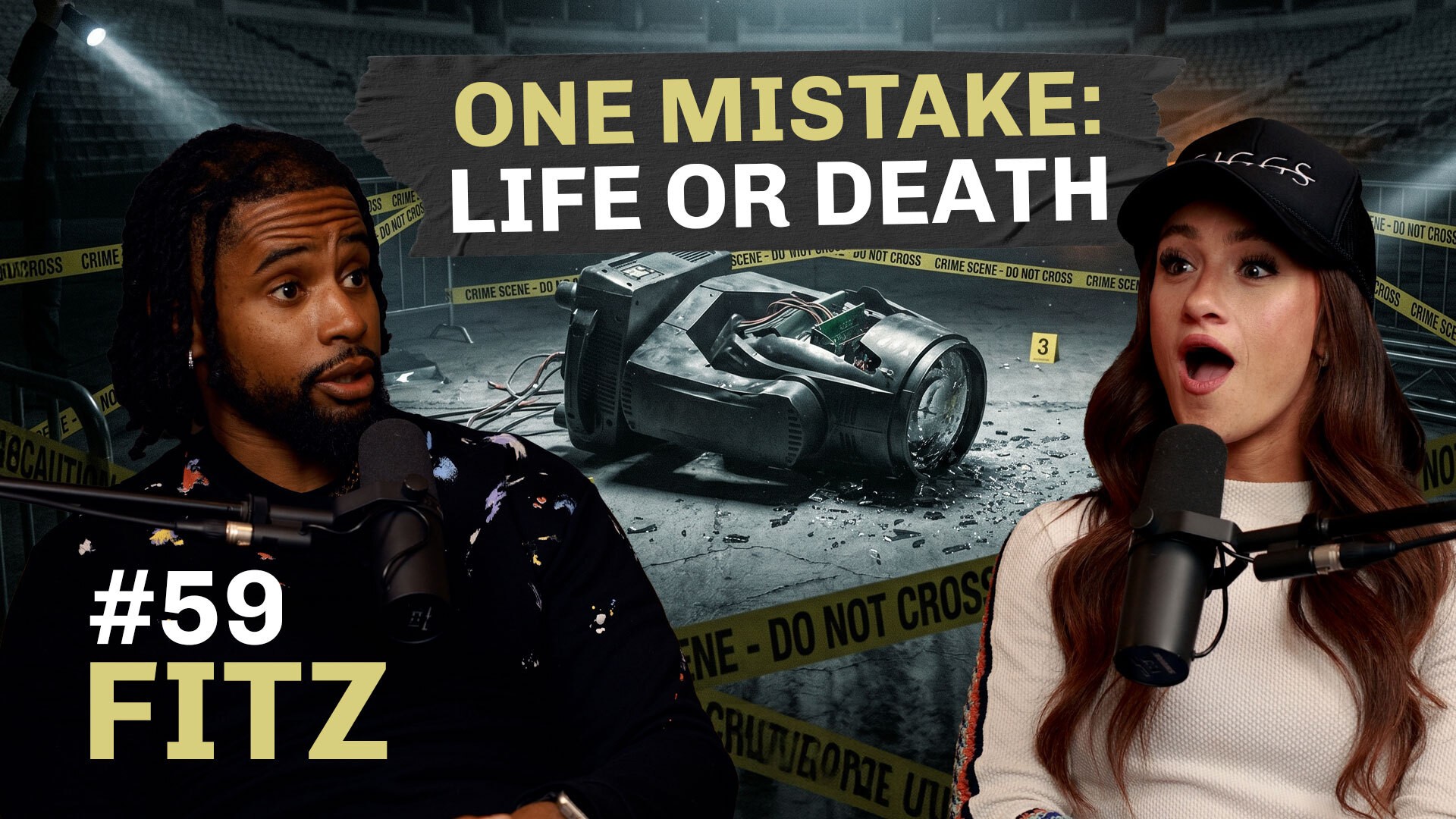
Recorded live at Rock Lititz — and the final episode of our Lititz run — this conversation is a return engagement. Brandon "Fitz" Fitzgerald is back one year later from episode #19, which became one of the most-shared conversations we've ever put out. The year between then and now has been a big one.
Fitz spent it as a production rigger for Playboi Carti, Post Malone, Beyoncé's Cowboy Carter Tour, and a creative gig in New Orleans during the city's biggest snowstorm in 55 years.
This is a denser, more technical conversation than year one, but it's also more personal. Fitz talks about the mental cost of going camp to camp, the legends who shaped him, and what it actually takes to put 100,000 pounds in the air every night.
Highlights — What You'll Learn
What it took to logistically pull off Beyoncé's Cowboy Carter Tour
Why local riggers don't get enough credit and why every venue is different
How snow load, dynamic load, and engineering specs quietly determine what's possible
The mental health side of constantly leaving and joining tour ecosystems
Why memorizing your rig is the most underrated skill in rigging
The legal liability that comes with being a tour rigger
Cowboy Carter, Eight Cargo Planes, and a Steel Team Across Two Continents
Fitz joined Beyoncé's Cowboy Carter Tour under the direction of Malcolm Weldon, who he calls one of the greatest production managers ever. The logistics were unprecedented: eight cargo planes, around 80 production trucks plus steel, four leapfrogging structures across the United States, and two more in Europe — one in London, one in Paris. Edwin Shirley handled the steel.
"All of the people and all of the bodies that made that happen — the people that don't get enough credit, the teams that went to go cross-load, that beat us out of the country and then beat us to the venue — like all of those people made that show happen."
His crew chief on the tour was Bill — an industry veteran whose preexisting relationships with steel teams and venues "took a lot of the bite out of certain things." Fitz says watching Bill operate showed him that long-term reputation isn't soft — it's the most functional asset on a tour.
After Beyoncé wrapped, Fitz had a few days off in Vegas, then flew straight to Stansted to start Post Malone's world tour. Beyoncé closed July 28th. Post Malone rehearsals started August 1st.
The Mental Cost of Going Camp to Camp
One of the most honest threads in this episode is something Fitz says doesn't get talked about enough: the emotional whiplash of touring.
"Every time you leave a camp or a tour and you start a new one, you're being ripped out of an ecosystem and then being thrust into another one. There's a very hard and fast adjustment of, okay, new personalities, new team, new bosses."
Fitz was featured in a Pollstar piece on mental health in touring last year, but says even that didn't fully capture what it's like to walk into Beyoncé's rigging team as the youngest guy in a room full of people he watched as a 19-year-old stagehand. He calls it being "a small fish in a really big pond."
The transition takes time. Even with relationships and reputation built up, the first few tours of someone's career hit hardest, and the cycle never fully stops.
Why Riggers Are "The Bad Guys"
This is the part of the conversation that working pros will replay. Fitz lays out the rigger's role in plain language:
"Riggers are usually the bad guys. We're the ones that say no. Our world functions on numbers, on science and math. So when we say no or we come with a different solution, it's like — listen to us. Or we work with different departments to figure out how to maintain the integrity of the show while maintaining safety. It's a constant give and take."
He gets into why that role is non-negotiable: one small mistake on a rig can cost someone their life. Riggers are legally on the hook — Fitz calls out the involuntary manslaughter exposure plainly. The standard can't slip. And the magic of the show, he argues, is built on whatever stress and re-engineering the rigging team absorbed quietly in the hours before doors.
"You didn't know that we were all stressed out crying in the corner 20 minutes ago because all of this was wrong. You got on stage and everything worked and everybody loved the show. That's what we do it for."
Snow Load, Dynamic Load, and Why Every Venue Is Different
Fitz gets into the technical side without losing anyone. When New Orleans hit its biggest snowstorm in 55 years during a creative gig with Court Lawrence, Fitz had to walk the building staff through what snow load even means — most southern venues don't have engineering specs for it.
He also breaks down dynamic load (the way moving objects increase force when they stop), why a 101,653-pound Playboi Carti rig was effectively 82,000 pounds at static, and why memorizing his entire rig — a habit he picked up from Bill — has changed how he problem-solves on the floor.
"When you have to deal with so much, if somebody comes to you with an issue, you might not have the piece of paper on you. Knowing your rig inside and out — it makes efficiency easier and you problem-solve faster."
He also gives local riggers their flowers. Every building is engineered differently. Renovations change specs. The relationships Fitz keeps with local heads across the country are part of how he keeps tours moving safely.
Mentors, Memory, and Standing on Shoulders
Asked what's gotten him here, Fitz doesn't hesitate. It's people. He runs through names: Tim Strawbridge at CFG, Tim Conder of Conder Engineering, Ming Chen in DC, Daniel Gilmore at Rhino, Roger Hutchings at the Kennedy Center, Carmen Rodriguez on Beyoncé, and his crew chief Bill.
A standout moment in the episode is when Bill showed Fitz a fax manifest from a Michael Jackson tour at the Capital Center in Landover, Maryland — from 1995, the year before Fitz was born. Fitz calls his career "a byproduct of great people who looked at me and said, hey, let me teach you something."
The Two Golden Rules
The episode ends with Fitz delivering the cleanest summary of his job we've heard:
"Two golden rules in rigging. Don't fall. Don't drop anything. First rule: more important — don't drop anything. Second rule: don't fall."
His advice to anyone trying to break into the business: talk to as many people as you can. Show up prepared. Be pleasant. Be professional. People work with people they like.
Listen to the full episode here and please follow the show and leave a review. Find your next gigg and join the #1 live events community at Giggs.
