Mental Health Support for Touring Crews: What Actually Works
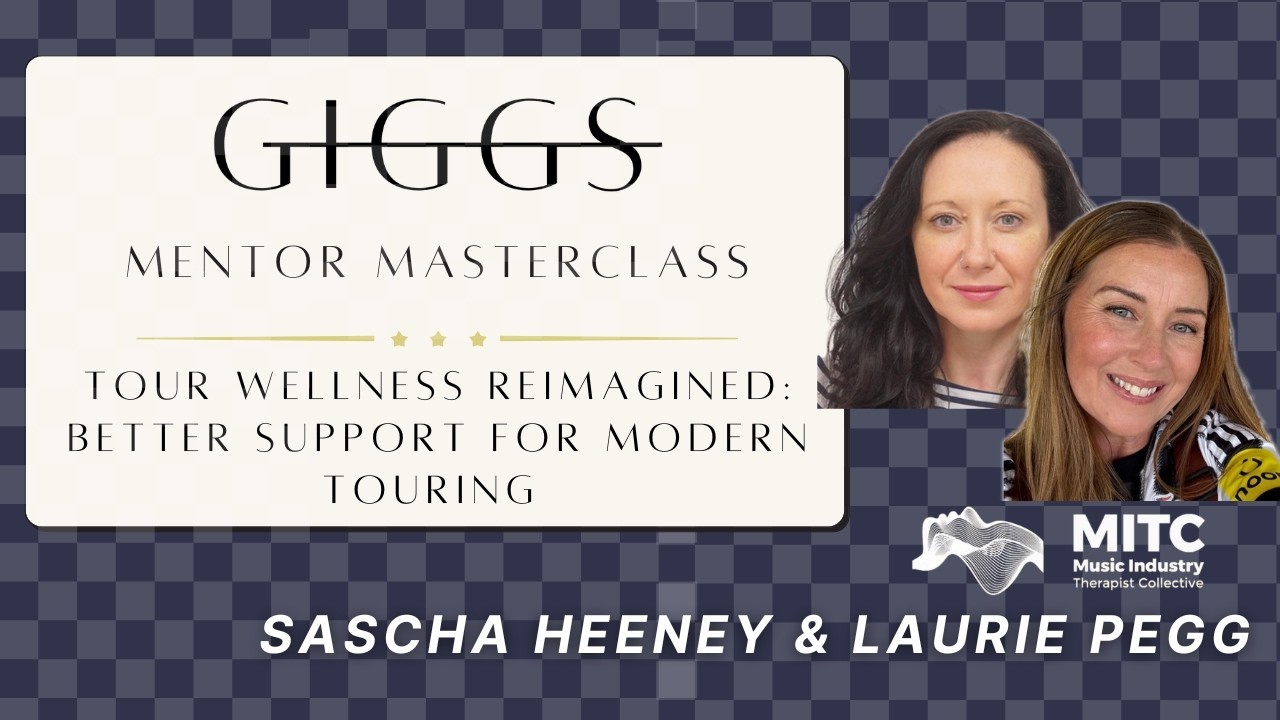
Touring has always demanded a lot from the people who make it happen. Long stretches away from home, unpredictable hours, high-pressure environments, and little institutional support. It's a combination that takes a real toll. The question isn't whether touring crews need mental health support. It's how to actually deliver it in an industry that's never had a blueprint.
Laurie Pegg and Sascha Heeney have spent their careers trying to answer that. Both come from deep roots in live music — Laurie from venues and festivals, ultimately landing at London's O2 Arena; Sascha from 30-plus years working across agents, promoters, and venues. Both retrained as mental health professionals while staying embedded in the industry. Together, they're core members of the Music Industry Therapy Collective (MITC), a nonprofit that exists specifically to make mental health support accessible to people who work in music.
What follows draws on their Giggs Mentor Masterclass, where they broke down everything from the structural realities of touring life to what 14 months on the Dua Lipa Radical Optimism Tour actually taught them.
Why Touring Is a Mental Health Problem the Industry Created
The mental health pressures of touring aren't accidental — they're structural. As Sascha put it plainly: touring lacks HR, it lacks occupational health, it's high in pressure and low on sleep. It can be, in her words, "a dysfunctional microcosm."
It's also an environment where asking for help has historically carried real professional risk. A significant portion of touring crews are freelancers, which means every conversation about struggle comes with a quiet calculation: will this make me look replaceable?
"People worry that if they talk up, or show what they deem as a sign of weakness, they'll be moved on," Sascha said.
That fear doesn't disappear when a welfare officer shows up, but it becomes easier to work through once crew understand that what they say stays confidential and won't affect their position on the tour.
Add to that the fact that crew are living inside three overlapping relationships simultaneously: the broader tour family with its shared objectives and subgroups; individual one-on-one relationships including friendships and family back home; and — most neglected of all — the relationship each person has with themselves. All three require maintenance. All three can break down. And on tour, when everything is compressed and intense, they tend to break down faster.
What a Tour Welfare Officer Actually Does All Day
The Dua Lipa Radical Optimism Tour ran for over a year. Sascha was embedded for all of it as a dedicated tour welfare officer — a role that, at the time, had never formally existed in this way.
Writing the job description before the tour started meant hypothesizing almost entirely. "We kind of wrote a job description, almost hypothesizing it, because we just didn't know what the need would be on the role."
What emerged was something closer to a general practitioner of tour wellbeing. On any given day, Sascha was acting as a confidant, mediator, conflict resolution support, health coach, safeguarding officer, and activity planner. She triaged physical health issues alongside mental ones. She managed external crises — bereavements, relationship breakdowns, the kind of things that don't pause because a tour is running. No two days were the same.
The practical logistics mattered as much as the clinical side. Sascha had her own room for confidential conversations. Crew had her WhatsApp. She was in the venue on every load-in day, not just show days. And critically, the service ran from catering staff all the way up to the artist.
"There wasn't a single person on this tour that didn't have access to this welfare service."
That universal access sent a message in itself.
The Trust Problem — And How to Solve It
One of the most consistent challenges wasn't logistics — it was getting people to use the service in the first place.
Veteran crew members were often the hardest to reach. They'd survived decades on the road without anything like this. Some were skeptical. Some were waiting to see whether Sascha would still be around in three months, or whether the whole thing would quietly disappear.
Her approach wasn't clinical. It was human. "Just being present, just being yourself — eventually it's continuation of care. The more they see you, the more you just get those little relationships built."
She also used activity planning as a kind of side door into trust. She'd find out what crew members were into and organize around it.
One real example: finding clay pigeon shooting in the next city for someone who she knew enjoyed it. She created WhatsApp groups around shared interests, organized group excursions on days off, and built a local resource page for every city on the tour listing the nearest yoga studio, pilates class, or sound healer, so crew could go independently if they didn't want a group setting.
The point wasn't to force engagement. It was to show that someone was paying attention. For veteran crew who would never knock on her door directly, knowing she was there for younger or more vulnerable colleagues was often enough.
"They loved to know that there was someone there for maybe the younger crew members or those that haven't really toured that well."
By the end of the tour, people Sascha had assumed would never engage had come to her. Time, consistency, and genuine presence were the tools.
The Data That Makes the Case
MITC didn't just collect anecdotes. Sascha gathered quantitative data at two points during the tour — early on and toward the end — anonymously, so crew could respond honestly. The results:
96% reported a positive experience of having a welfare officer on tour
88% said they would recommend having a welfare officer on future tours
84% felt the presence of a welfare officer contributed to a more supportive tour culture
Crew also reported managing stress more effectively, feeling more empowered to cope, and experiencing a greater sense of belonging and workplace safety.
For anyone trying to make the case to a tour director, promoter, or artist management that welfare support is worth budgeting for, MITC's impact report — built from this tour — is likely the most useful document currently available. It's empirical, recent, and specific to touring. As Sascha noted: "Having hard, quantitative data that you can show is probably the strongest argument you can have, as well as testimonials."
When You Can't Afford a Full-Time Welfare Officer
Both Laurie and Sascha are clear-eyed about one thing: a dedicated tour welfare officer is a gold standard that most tours can't currently access. The Dua Lipa tour was a major global production. Most tours aren't.
MITC is actively building infrastructure for the rest of the industry.
Their pay-it-forward scheme is designed so larger organizations donate funding to subsidize welfare support for smaller tours. Support won't look the same on every tour — it might be a pre-tour workshop, an opening-night briefing, or a post-tour debrief. The model adapts to what each tour actually needs.
They've also launched an online welfare coaching platform, available 24/7 and staffed by MITC therapists across multiple time zones, which matters when your crew is in a hotel room at 2am struggling before a load-in.
For those wanting to advocate for mental health support internally — whether at a label, festival, or production company — Laurie's advice is straightforward: tour managers are a good demographic to target first, followed by any artist or manager who's genuinely bought in.
"My dream is that it will be in the budget template, and it won't even be a second thought."
And sometimes the most effective intervention doesn't require a budget at all. Sascha shared an example from another tour where a lighting crew member could see people around her were struggling but didn't know how to address it formally, so she built her own solution.
She put together a flight case stocked with resources: copies of MITC's touring mental health book, personal care items, and a "need to talk" voucher that crew could pick up and use to open a conversation with each other. People started coming to it bit by bit.
"Just knowing that it's there is enough to create a culture on tour where people know it's a good environment to be in."
The Simplest Tool for Supporting Someone on Tour
Amid everything discussed, one of the most practical moments came from Laurie, who shared a framework MITC teaches in workshops — one simple enough to be used in primary schools, and transferable enough to reshape how people support each other on the road.
When someone is struggling, ask them: do they want to be heard, helped, or hugged?
Heard means they need to talk without receiving advice or solutions in return. Helped means they need practical support and want to know the right place to go. Hugged — and this doesn't have to be literal — means they just need presence.
The instinct to immediately problem-solve when someone is in distress often makes things worse. Knowing which mode of support someone actually needs changes the entire dynamic of the conversation. "We can't rely on telepathy," as Laurie put it. "We can't just think we understand what someone needs. The key is asking them."
Key Takeaways
Touring lacks the HR and occupational health infrastructure found in most other industries — mental health support has to be built in deliberately, not assumed.
Freelance status creates a specific fear around vulnerability; confidentiality and psychological safety have to be demonstrated through action, not just stated.
Building trust with skeptical or veteran crew takes time and consistency — activity planning and informal presence can be as effective as formal intervention.
Quantitative data is currently the strongest tool for advocating to tour directors and management; MITC's Radical Optimism Tour impact report is available on request.
A welfare officer role spans mediation, safeguarding, crisis management, and community building — not just therapy.
When a full welfare officer isn't possible, a pre-tour workshop, a city resource guide, or even a crew-built resource station can meaningfully shift tour culture.
Before offering support, ask: do they want to be heard, helped, or hugged? The answer changes everything.
About the Guests
Laurie Pegg is an integrative counsellor and member of the Music Industry Therapy Collective. She spent over 20 years in the live music industry — including roles in festival promotion, music sponsorship and marketing, and as Content Manager and booker at London's O2 Arena — before retraining as a therapist to address the mental health gaps she experienced and witnessed firsthand.
Sascha Heeney is MITC's dedicated Touring Welfare Officer, with over 30 years in live music and 15 years as a psychiatric nurse specialising in complex care. In 2024, she joined Dua Lipa's Radical Optimism Tour as the first welfare officer of its kind — providing confidential psychological support, crisis management, and restorative care to the full touring party across 81 shows worldwide.
More on MITC's services, resources, and initiatives at musicindustrytherapists.com.
